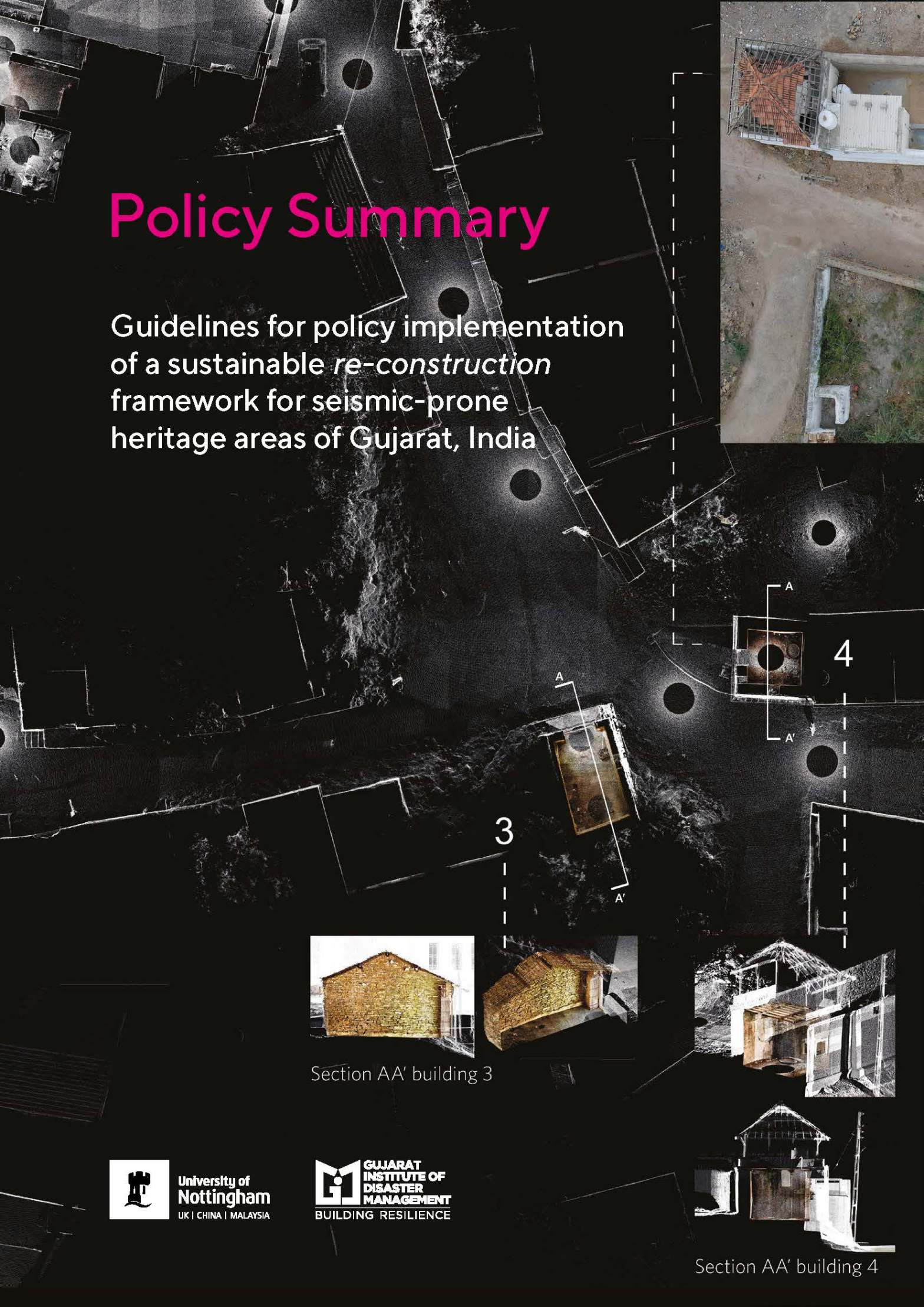
We have published a Policy Summary, available here: https://doi.org/10.25878/6yq6-qe39
The purpose of this document is to convey key actions and coordination between stakeholders towards the documentation and conservation of heritage buildings and places in historic villages in Gujarat, India, at risk of damage due to seismic events and other natural hazards, including authorities, academic Institutions, non-governmental Organisations (NGOs), local communities and industry.
This document introduces and advocates for the use of a framework (Devilat et al. 2021, NTU et al. 2022) based on advanced documentation technologies, such as 3D laser scanning (or LiDAR), in combination with aerial and terrestrial photography and social surveys, to support accurate, detailed and comprehensive records. This facilitates expert assessment and evaluation of heritage buildings and places, especially if done as a continuous practice, informing the preparatory development of risk management plans to reduce damage and loss. After disasters, as a damage assessment methodology to enhance re-construction processes, the reuse of less-affected heritage buildings and reduced demolition is considered. It also recommends incorporating these records in wider Geographical Information Systems and the sensitive use of the documentation for public engagement, understanding and acceptance.
This document has been elaborated in partnership between the University of Nottingham (UoN) and the Gujarat Institute of Disaster Management (GIDM) and is a product of phase 4 of the 3D for Heritage India research project: “Exploring Policy implementation, dissemination and applicability of a sustainable re-construction framework for seismic heritage areas of Gujarat, India” funded by the University of Nottingham.
Thanks to the editors of this document: Nisarg Dave and Shubham Daberao from the Gujarat Institute of Disaster Management (GIDM); along with Bernadette Devilat and Felipe Lanuza, from the Architecture, Culture and Tectonics Research Group, Department of Architecture and Built Environment, University of Nottingham.
Thanks to Repaul Kanji, Ashish Trambadia and Aditya Singh from the Aabhat Hunnarshala Foundation, who reviewed and commented on this document prior to its publication.
Previous phases of 3D for Heritage India informing this work have been funded by the UKRI Arts and Humanities Research Council (AHRC) and the Department for Culture, Media and Sport (DCMS). Partners of previous phases included: Center for Heritage Conservation CEPT Research and Development Foundation (CHC CRDF), Hunnarshala Foundation, Nottingham Trent University (NTU) and ICCROM. Please check our research team section for more details.

